6. Runtime View
Scenario 1: A complete publish run
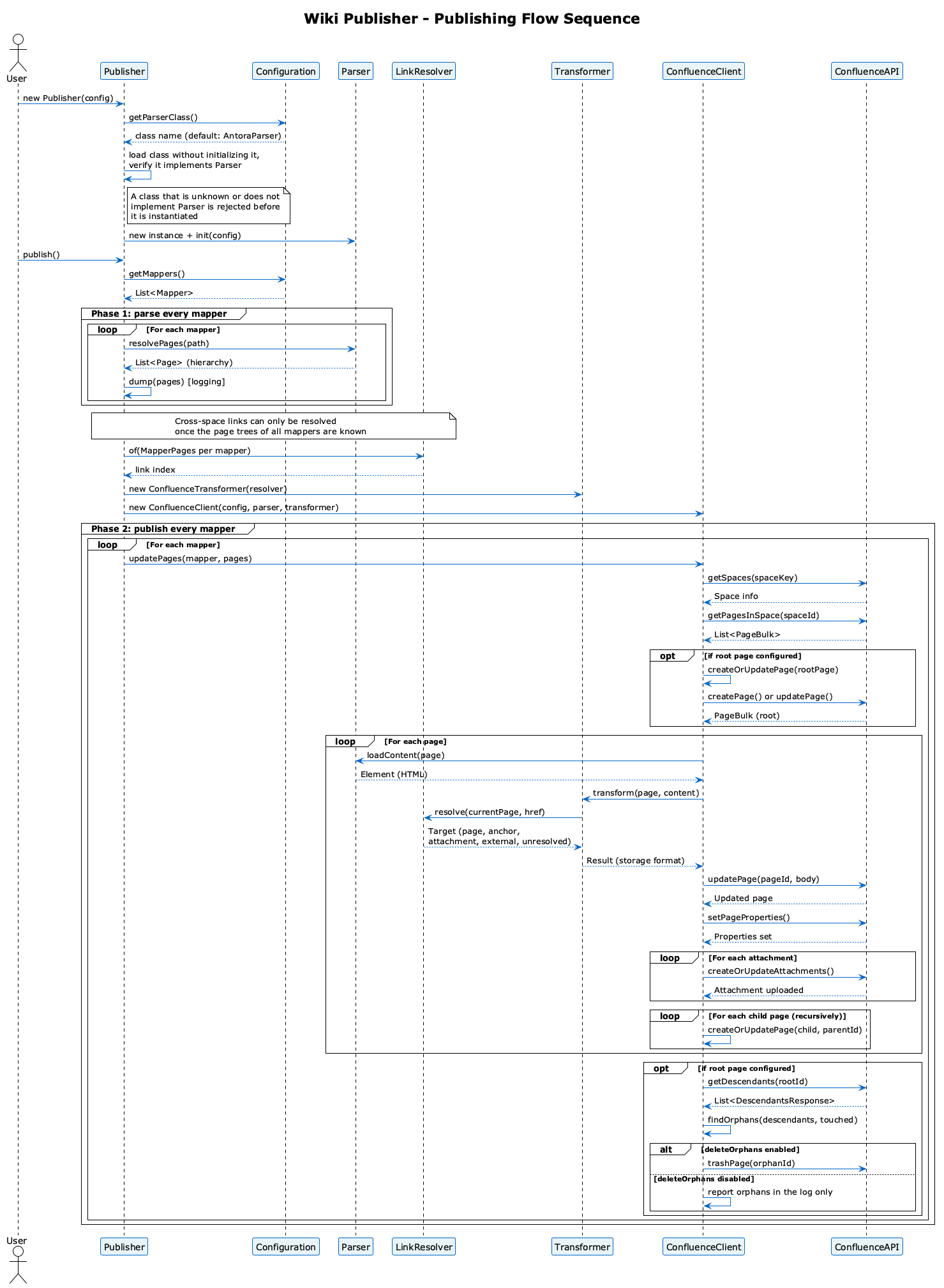
The run splits into two phases, and the split is the central design decision of the runtime behaviour:
Initialization — the parser class from Configuration.parserClass is resolved, verified and
instantiated, then init(config) hands it the configuration.
Phase 1 — parse every mapper. Each configured mapper is parsed into a Page tree and logged.
Nothing is written to Confluence yet. A mapper that fails to parse is recorded and skipped; its
pages are then missing from the link index, which is why the failure is reported at the end of the
run.
Building the link index. The page trees of all mappers become one LinkResolver. Only now can a
link be expressed as "page X in space Y" — before this point, a link into a space that has not
been parsed yet is unresolvable.
Phase 2 — publish every mapper. Per mapper: look up the space, create or update the root page, then walk the page tree recursively. Per page: load the content, transform it (resolving links on the way), write the body, set page properties, upload attachments, recurse into children. Afterwards the orphan check runs.
| The ordering is not an optimisation, it is a correctness requirement. Publishing mapper by mapper in one pass would make cross-space links unresolvable in whichever space happens to be processed first. |
Scenario 2: Nothing has changed
The idempotence case, and the one that runs most often in practice:
-
ConfluenceClientreads the page propertypage-content-hashof the existing page. -
The transformed body is hashed and compared.
-
On a match, no update call is made: no new version, no watcher notification, no entry in the page history.
-
Attachments are compared the same way through the hash in their upload comment (
sha256:…).
The page is still marked as touched, which matters for the next scenario.
Scenario 3: A page was deleted locally
  local site          Confluence space           result
  ──────────          ────────────────           ──────
  intro.adoc    ───►  Introduction         ───►  touched, kept
  setup.adoc    ───►  Setup                ───►  touched, kept
  (deleted)           Old Chapter                not touched ──► orphan
After all pages of a mapper are written, syncPageStructure loads every descendant of the root
page and subtracts the set of touched page IDs. What remains was published by an earlier run and
no longer exists locally.
-
With
deleteOrphans=true(the default), the orphan is moved to the trash — recoverable in Confluence. -
With
deleteOrphans=false, the log saysWould move to trash: …and nothing is removed. This is the preview mode: a real build against the real space that shows exactly what arming the flag would do.
The result list is ordered deepest first, so trashing a page never orphans its own children mid-run.
Without a configured root, orphan detection is skipped entirely and logged as such.
The scope would otherwise be the whole space — including pages that have nothing to do with this
documentation.
|
Scenario 4: Error handling
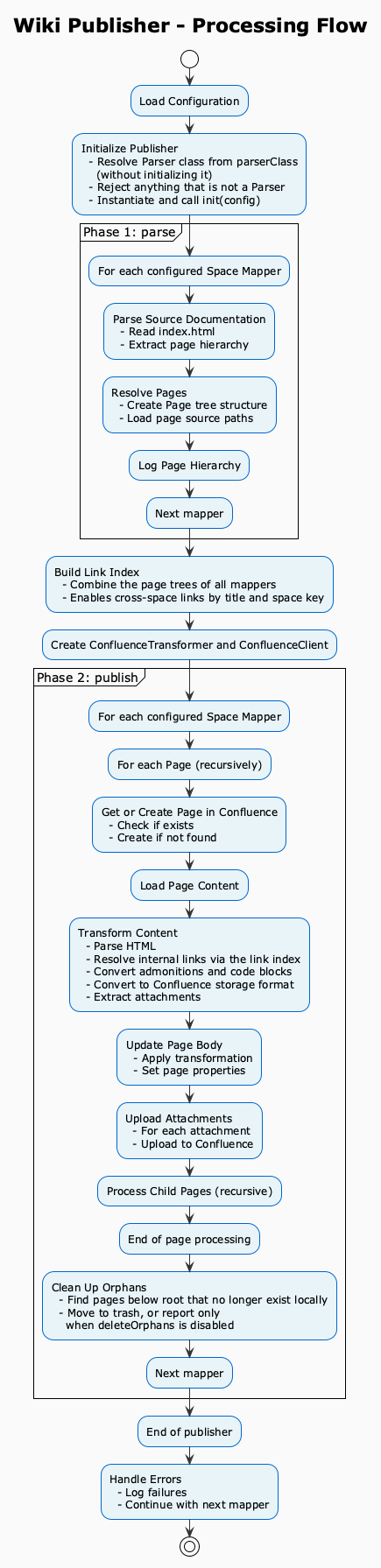
Failures are handled at the granularity of a mapper, not of the build:
| Failure | Reaction | Effect on the build |
|---|---|---|
Unsafe href in the source HTML |
Logged as a warning, navigation entry kept without a source |
Build continues |
A link that cannot be resolved |
Counted and reported per page, link text kept without a link |
Build continues |
One page fails to transform or write |
Logged with a stack trace, mapper marked as failed |
Mapper reported at the end |
A whole mapper fails to parse |
Logged, mapper skipped, its pages missing from the link index |
Mapper reported at the end |
Parser class unknown or not a |
|
Build fails immediately, nothing is published |
At least one mapper failed |
|
Build fails after all other mappers were published |
Transient HTTP failures are retried once through a small retry helper before they count as a failure.